
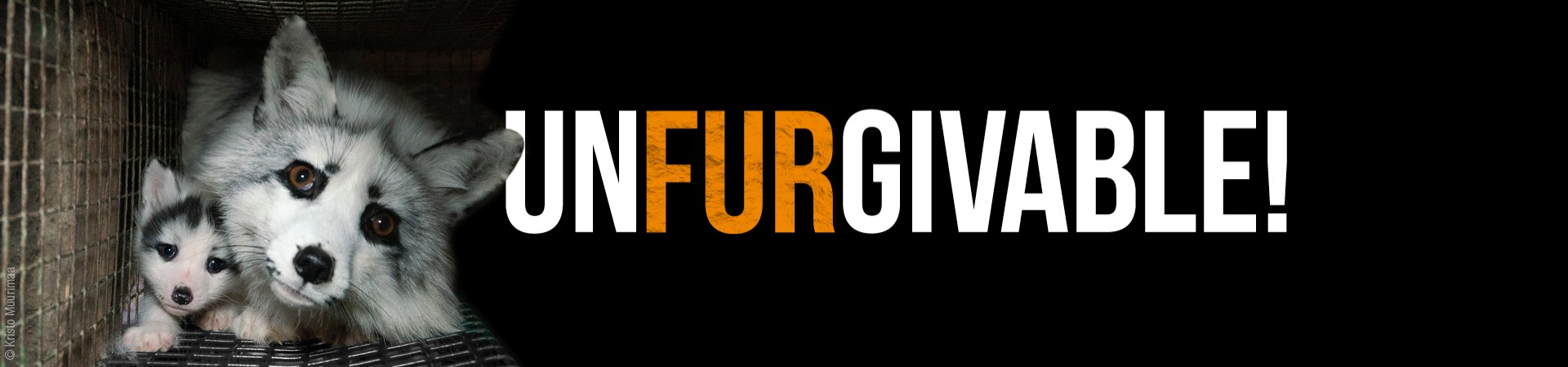
It is UNFURGIVABLE that:
-
- Sentient animals continue to be kept and killed on fur farms solely to satisfy the frivolous demands of the fashion industry, despite the availability of humane, warm and beautiful alternatives to real fur.
-
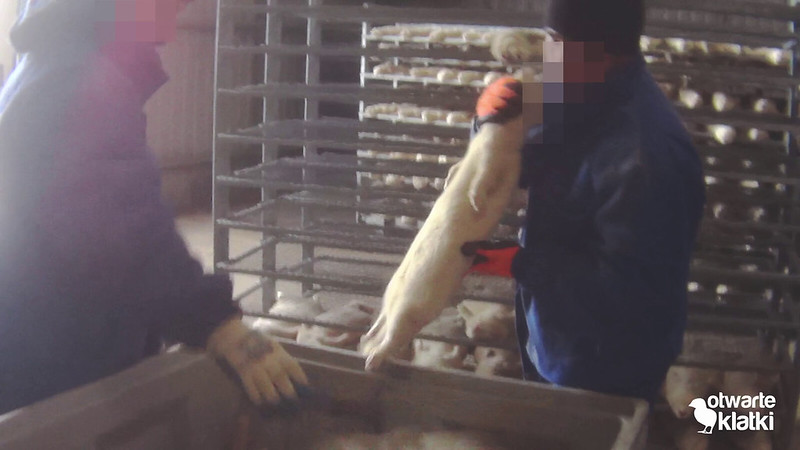
- Mink, foxes, raccoon dogs and chinchillas continue to endure short and miserable lives in small wire cages that cannot possibly support their natural behaviours or welfare needs, leading to serious and systemic suffering.
-
- Introduction of minimum ‘welfare standards’ for fur farmed animals is being mooted as a solution when the European Food Safety Authority has already concluded that their suffering ‘cannot be prevented or substantially mitigated’ under current fur farming systems.
-
- Fur farming is still allowed in a few EU Member States, despite the well‑documented role of fur farms in spreading zoonotic diseases and their potential to fuel future pandemics.
-
- Fur farming persists despite being a resource‑intensive industry with significant environmental impacts – from greenhouse gas emissions and water and soil pollution to stench, biodiversity loss, and threats to native species.
-
- Fur farming continues when the environmental and public‑health costs of the sector far exceed its gross value added. With the industry generating a €9.2 million loss, it actively diminishes – rather than contributes to – the EU economy.
-
- Fur farming continues to exist in the European Union, even though overwhelming public opinion and concerns about animal welfare has already driven 18 Member States to ban and phase out this cruel practice. A ban on the import and placing on the market of fur farmed products would be the next step towards ending fur cruelty in the EU.
Now is the time to act
This is a pivotal moment. With compelling evidence on animal welfare, biodiversity protection, and economic viability – and with more than 1.5 million people signing the European Citizens’ Initiative for a Fur Free Europe – it would be UNFURGIVABLE if an EU-wide ban on fur farming and farmed fur product trade is not delivered now.
An EU-wide ban is not only feasible; it is necessary. It should be accompanied by just transition arrangements for remaining fur farmers through compensation, retraining, and employment programmes.
Europe has the opportunity – and the responsibility – to lead by example. The time to end fur farming is now.
Animal Welfare: Wild Animals Do Not Belong in Cages
The European Food Safety Authority’s (EFSA) scientific opinion on the welfare of animals on fur farms has confirmed that the current cage-based fur farming system cannot meet the physical or behavioural needs of animals, such as mink, foxes, raccoon dogs, and chinchillas. According to EFSA, neither prevention nor meaningful mitigation of welfare problems is possible within existing production models. No alternative systems for keeping these species have ever been commercially implemented and scientifically assessed.
EFSA’s findings align with longstanding concerns among veterinarians, scientists, and civil society. Confining inherently wild species in small wire cages for nonessential luxury products is a systemic welfare violation. A legislative proposal banning fur farming across the EU would reflect both scientific evidence and citizens’ expectations.
Fur Farming and Zoonotic Disease Risks
Fur farming poses a serious public health risk by creating ideal conditions for zoonotic diseases to emerge and spread. For example, SARSCoV2 has repeatedly circulated on mink farms, where high density confinement enables rapid transmission, viral mutation and spillover back into humans. Nearly 500 mink farms across Europe and North America have recorded SARSCoV2 outbreaks, with documented mink-to-human transmission. This led to widespread culling on mink during the COVID-19 pandemic.
Fur farms have also experienced outbreaks of Highly Pathogenic Avian Influenza (HPAI), including mutations associated with mammal-to-mammal spread, raising further concerns about pandemic potential. These low-welfare, high-density systems therefore act as high-risk interfaces where dangerous viruses can evolve and spill over into human-populations.
Environmental Impact of Fur Farming
Fur farming is an extremely resource‑intensive industry that places a disproportionate burden on the environment. It contributes directly to greenhouse gas emissions, adding avoidable pressure to the climate at a time when the EU is committed to reducing its carbon footprint.
At the same time, fur farms generate significant water and soil pollution, with waste run-off affecting the quality of local ecosystems and water resources. Communities located near fur‑farming operations are also exposed to particulate matter, and persistent and unpleasant odours, which degrade air quality, diminish residents’ quality of life and reduce property values.
Taken together, these impacts highlight the extensive environmental footprint of a sector that offers no essential societal benefit while imposing considerable and unnecessary ecological costs.
Fur Farming Threatens Native Biodiversity
Fur farming poses a serious threat to native biodiversity. The industry has facilitated the introduction of four invasive alien species into Europe – coypu, muskrat, raccoon dogs and American mink – all of which are now listed as Invasive Alien Species of Union Concern, underscoring both the ecological damage and the significant economic harm they cause.
Although coypu and muskrats are no longer kept commercially, a derogation in the EU Invasive Alien Species Regulation still allow American mink and raccoon dogs to be kept for fur farming under authorisations and permits. This loophole undermines conservation efforts. Only a full EU‑wide ban on fur farming can eliminate the risks these species pose to Europe’s native biodiversity.
Economics: A Declining and Unsustainable Industry
The fur sector is in long-term decline. In just ten years, the number of fur farms in Europe has fallen by 73%, production has dropped by 86%, and the value of sales has collapsed by 92%. An economic analysis published in 2025 found that the EU fur sector generates a negative gross value added of €9.2 million – comparable to obsolete sectors, such as video rental.
With major fashion houses eliminating fur and consumer demand continuing to plummet, public funds should not be used to prop up an industry that is both ethically and economically indefensible. Transition support for the small number of remaining farmers should instead be channelled towards viable and sustainable livelihoods.
Member State Bans: Europe Is Moving Away from Fur Farming
A growing majority of EU Member States have already banned fur farming or imposed conditions that render it effectively impossible. Countries with full bans now include Austria, Belgium, Bulgaria, Croatia, Czech Republic, Estonia, France, Ireland, Italy, Latvia, Lithuania, Luxembourg, Malta, the Netherlands, Romania, Slovenia, Slovakia, and most recently Poland.
Denmark, Sweden and Hungary have banned the keeping of specific species, while Germany introduced stringent regulations that rendered fur farming economically unviable. This growing patchwork of national restrictions reflects the clear ethical direction of travel but also highlights the urgent need for harmonised EU legislation.
A Level Playing Field: Ensuring Coherence Across the Single Market
The lack of an EU-wide ban on fur farming has led to the fragmentation of the internal market. Countries that have taken ethical and evidence-based steps to ban fur farming are disadvantaged by ongoing production in a minority of Member States. Without coherent legislation at EU level, fur farming can continue in pockets of the EU despite this cruel practice being rejected by both citizens and animal welfare scientists.
A harmonised EU approach is essential to ensure equal standards for animal welfare across all Member States, to protect public health, prevent ecological and environmental harm across borders, avoid market distortions, and to futureproof EU policy in alignment with societal values.